Daniel Yamin
Senior AI Engineer & Data Scientist | Always Building

Tel Aviv, Israel
I build LLM-powered applications and agentic workflows for clinical genomics at Franklin by QIAGEN, where I’m the go-to technical resource for AI development across the organization.
Before that I spent a decade shipping production systems — DeFi risk platforms at Chaos Labs, IoT security at Microsoft Azure, real-time network anomaly detection at Allot — and completed an MSc in computational neuroscience at Tel Aviv University, where I co-developed a way to measure human memory from eye movements alone, published in Nature Communications Psychology.
I studied how brains remember. Now I build systems that give AI agents memory, tools, and judgment.
What I do
AI engineering
I design, build, and productionize LLM applications and agentic workflows end-to-end: identifying the opportunity, prototyping, building evaluations, and shipping to production. A lot of my work turns scientific literature and unstructured clinical content into structured, actionable data with NLP and text mining.
Data science & algorithms
Machine learning for genomic and clinical data today; before that, economic risk simulation for DeFi protocols securing billions in assets, security analytics for millions of IoT devices, and real-time anomaly detection on live network traffic. Signal processing, statistics, and distributed computing throughout.
Memory research
My MSc research at Tel Aviv University (Yuval Nir Lab) developed MEGA — a paradigm that quantifies episodic memory from anticipatory eye gaze, with no verbal report needed. Published in Nature Communications Psychology and covered by Channel 13 News, The Times of Israel, and Neuroscience News.
From human memory to machine memory
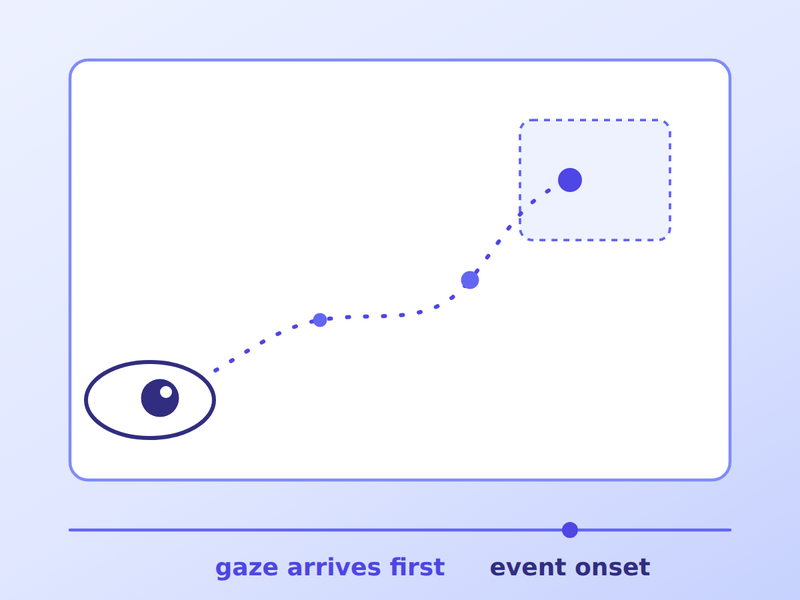
My research asked a strange question: how do you detect a memory the person can’t tell you about? Our answer was to read it from the eyes — anticipatory gaze reveals a memory trace seconds before the remembered event appears on screen, even when people say they don’t remember.
Building agentic systems raises the engineering version of the same question: what should an intelligent system remember, and how do you prove it remembered? Memory, evaluation, and observability for AI agents aren’t buzzwords to me — they’re the problem I studied in the lab, now in production form.
Experience at a glance

Education: MSc Computational Neuroscience, Tel Aviv University (GPA 98) · BSc Computer Science & Cognitive Science, Open University of Israel (GPA 92, honors track scholarship)
Open source
The MEGA research implementation is open source (MIT), together with its experiment presentation suite — the full pipeline behind the paper, from stimulus presentation to gaze-based memory classification.
Let’s talk
I’m always happy to hear about hard problems at the intersection of AI, data, and product — collaborations, speaking invitations, or a problem you think I’d enjoy.
news
| Sep 06, 2026 | The blog is live with two essays: I measured memories people couldn’t report. Now I build memory for AI agents, and Lessons from shipping LLM agents where wrong answers matter. |
|---|---|
| Aug 11, 2025 | Our paper “Anticipatory eye gaze as a marker of memory” is out in Communications Psychology — measuring episodic memory from gaze alone, no verbal report needed. Covered by Channel 13 News, The Times of Israel, and Neuroscience News. |
| May 12, 2025 | QIAGEN announced the acquisition of Genoox, where I lead LLM and agentic-AI initiatives — the Franklin clinical-genomics platform joins the QIAGEN Digital Insights portfolio. |
| Aug 14, 2024 | “Seeing the Future: Anticipatory Eye Gaze as a Marker of Memory” — the preprint of our no-report memory paradigm — is up on bioRxiv. |